Trends


If you run supply chain operations, 2026 feels like a turning point.
Not "digital transformation is coming" — we've heard that pitch for a decade. More like "the software I bought three years ago can't keep up anymore."
AI agents are making procurement decisions autonomously. Control towers are shifting from dashboards to decision engines. And that spreadsheet-based demand planning process? It's becoming a competitive liability.
I'm not here to sell you on the next wave of supply chain buzzwords. I'm here to show you what's actually changing right now — backed by numbers from Gartner, McKinsey, Accenture, the World Economic Forum, and the organizations that actually measure this stuff.
The 12 supply chain software trends reshaping 2026:
Let's get into it.
Here's the shift that changes everything else: AI is moving from "tool you query" to "system that makes decisions."
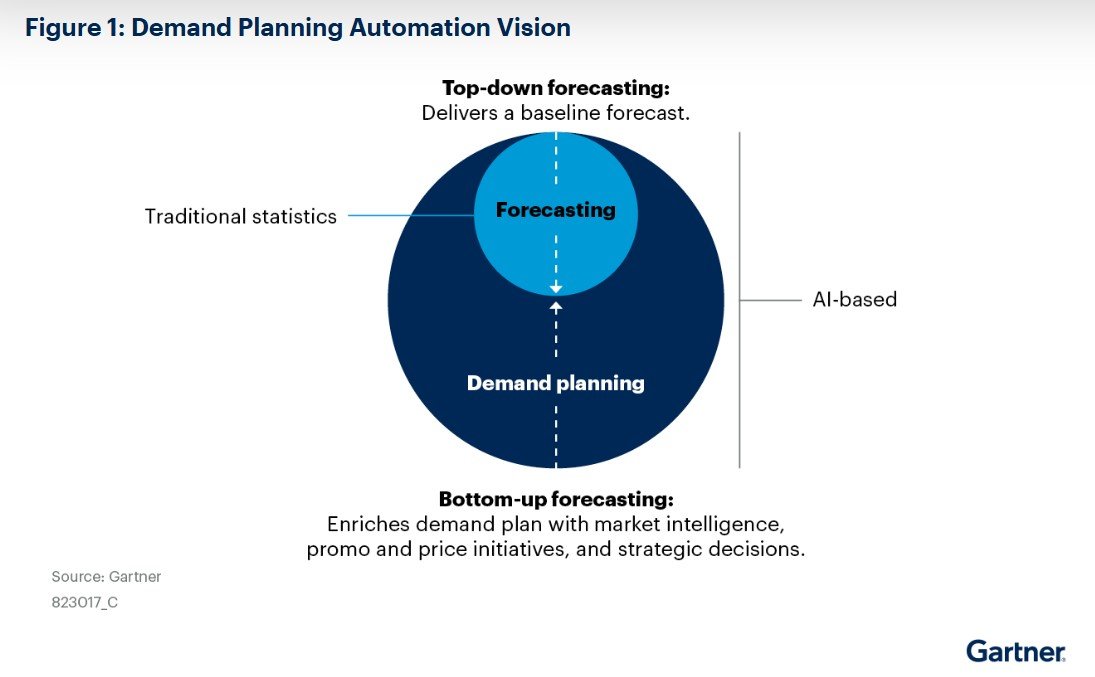
According to Gartner's supply chain technology predictions, 70% of large organizations will adopt AI-based supply chain forecasting by 2030. The AI-in-supply-chain market is forecast to grow to $40.53 billion by 2030 at a 28.2% CAGR.
The ROI is becoming undeniable. McKinsey reports more than a 5% revenue uplift in supply chain and inventory management from generative AI deployments. And that's just the early adopters.
Salesforce launched Agentforce with pre-built AI agents for procurement, inventory management, and supplier evaluation. These aren't chatbots — they're autonomous systems that reason, plan, and act on behalf of the organization.
Blue Yonder integrated agentic AI across their platform, with agents handling demand sensing, inventory optimization, and logistics orchestration without human intervention for routine decisions.
SAP expanded their AI copilot capabilities across S/4HANA, enabling natural language queries and autonomous exception handling in procurement and logistics workflows.
The question isn't whether to adopt agentic AI — it's how to stay relevant when AI handles execution. The supply chain professionals who thrive in 2026 are the ones who get really good at strategy, exception handling, and knowing when to override the machine.
Your new job isn't managing purchase orders.
It's training AI systems to understand what success looks like for your business — and stepping in when they're wrong. (For a deeper dive into how AI agents are transforming enterprise software beyond supply chain, see our generative AI trends for 2026.)
End-to-end visibility is no longer optional. In fragmented, distributed networks, control towers are taking center stage.
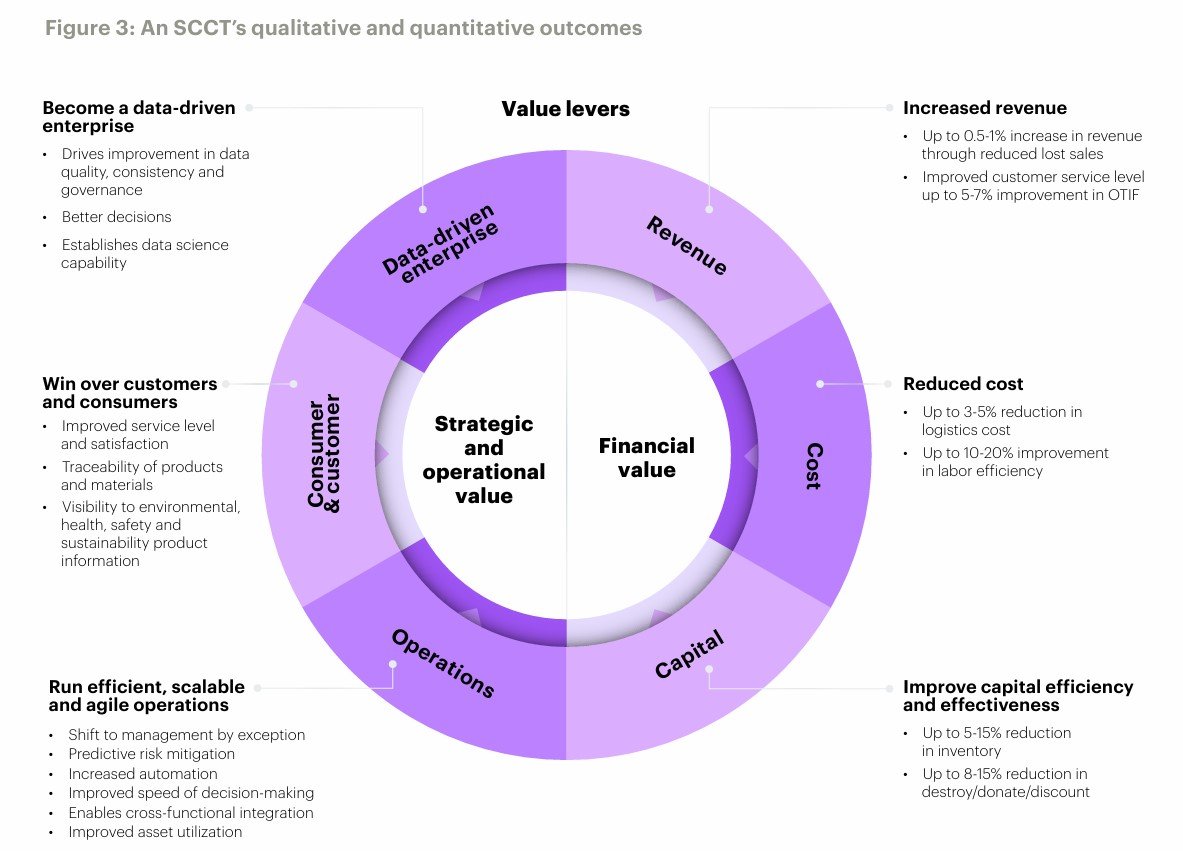
Source: Accenture, "Supply Chain Control Tower: From Visibility to Value" 2022
The global supply chain visibility software market was estimated at $3.5 billion in 2026 and is expected to grow to $10.9 billion by 2034, according to GM Insights market analysis. That's a 13.4% CAGR — and the acceleration is just starting.
Here's the stat that should worry every operations leader: according to Procurement Tactics' supply chain statistics report, only 6% of businesses have full supply chain visibility today. The remaining 94% are flying partially blind.
Project44 expanded their real-time visibility platform to cover ocean, air, rail, and parcel alongside truckload, providing unified tracking across all transportation modes.
FourKites integrated machine learning for predictive ETAs, alerting companies to delays before they cascade into production problems.
SAP launched enhanced control tower capabilities within their Integrated Business Planning suite, combining planning and execution visibility in a single platform.
A control tower that only displays data is no longer enough. The 2026 evolution is toward "decision towers" — systems that don't just show you problems, but recommend solutions and execute routine responses automatically.
The companies winning aren't the ones with the prettiest dashboards. They're the ones whose control towers integrate with execution systems and take action in real time.
Digital twins have moved from "interesting concept" to "essential infrastructure."
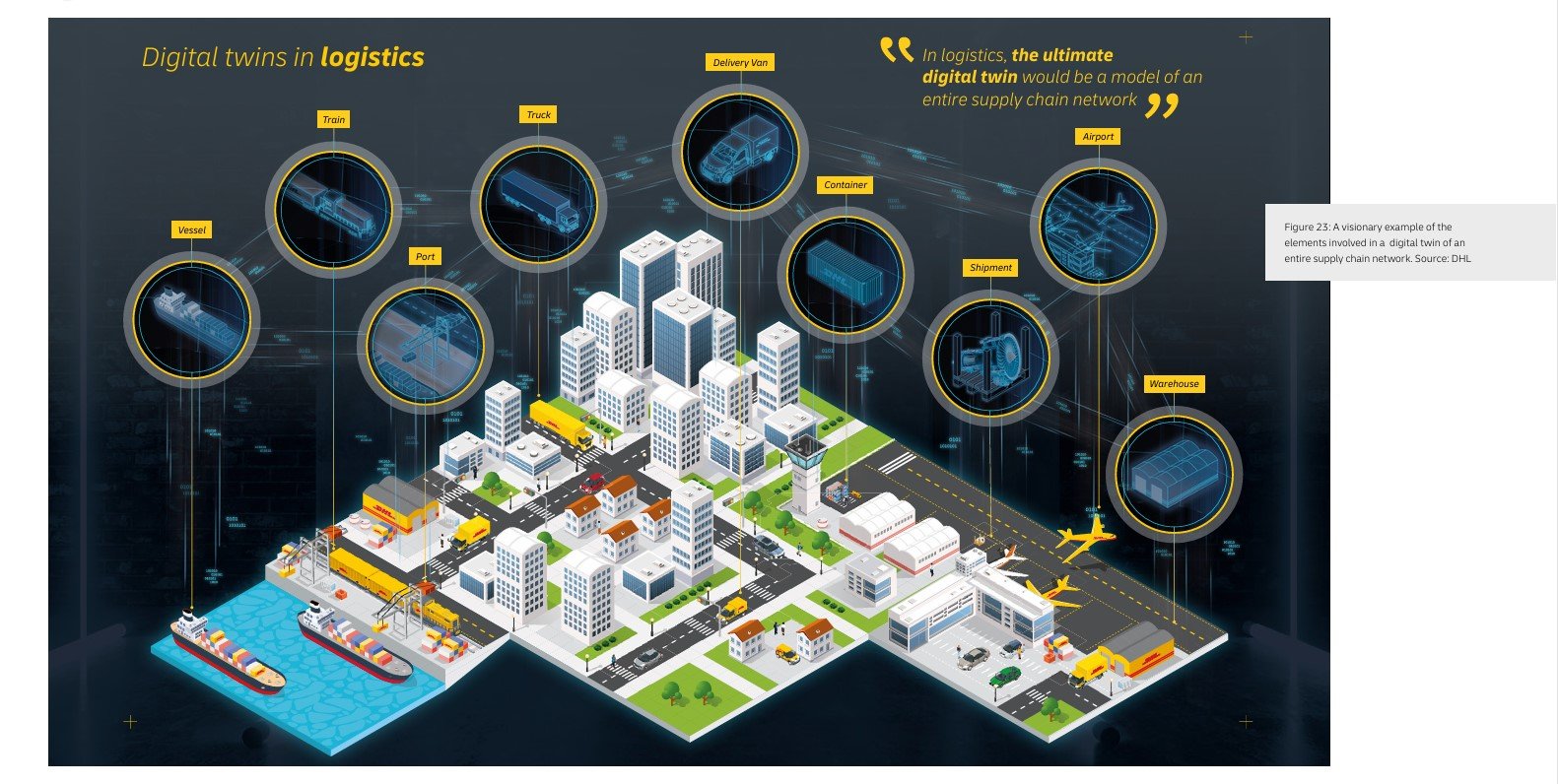
According to McKinsey's manufacturing survey, 86% of manufacturing executives said digital twins were applicable to their organization, while 44% had already implemented them and another 15% were planning deployment.
The market reflects this adoption surge. According to Market.us analysis, the supply chain digital twin market is projected to grow from $2.8 billion in 2023 to $8.7 billion by 2033 — a 12.0% CAGR driven by the need for resilience and scenario planning.
Unilever built a digital twin of their entire supply chain network, enabling real-time simulation of disruption scenarios and optimization of inventory positioning across 190 countries.
DHL deployed digital twins for warehouse operations, simulating layout changes, staffing levels, and automation investments before committing capital.
Siemens extended their digital twin platform to include supplier networks, enabling visibility into tier-2 and tier-3 supplier operations for risk management.
The post-pandemic era underscored the need for more resilient and agile supply chains. Digital twins are becoming the strategic tool for identifying bottlenecks, assessing supplier risks, optimizing route planning, and improving demand forecasting — all before committing real resources.
In 2026, the question shifts from "should we build a digital twin?" to "how complete is our twin, and how fast can we run scenarios?"
The warehouse labor math has fundamentally changed. Real wages escalated 15-20% during 2024, and the pressure isn't letting up.
According to Roots Analysis market research, the global warehouse robotics market is valued at $8.75 billion in 2026, projected to reach $77.89 billion by 2040 — a 15.69% CAGR. The worldwide warehouse automation market has now reached approximately $30 billion in 2026, according to Precedence Research.
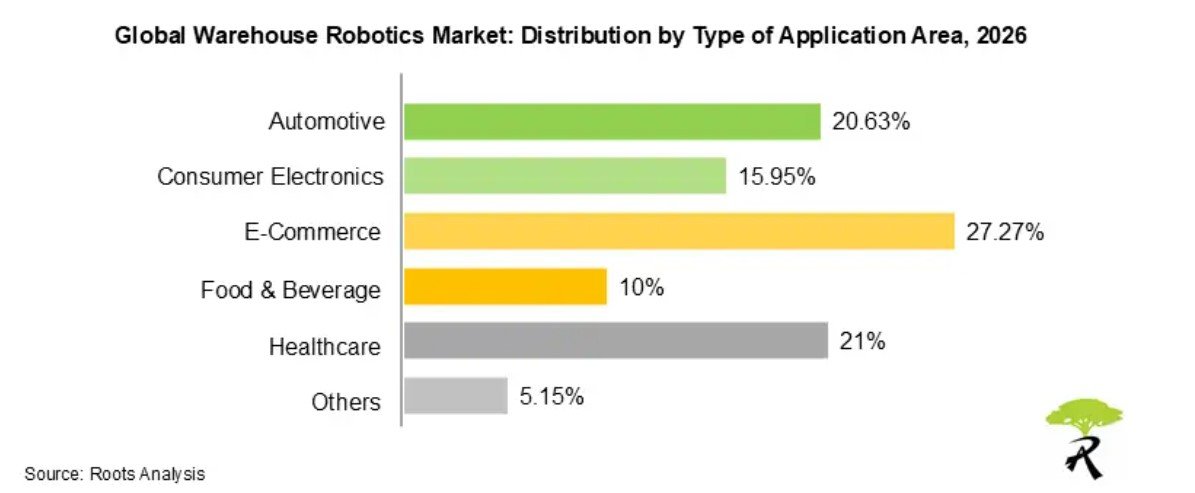
The deployment numbers are staggering. According to ABI Research's robotics outlook, mobile robots will generate $75 billion in revenue by 2030, with Automated Storage and Retrieval Systems (AS/RS) overtaking material handling as the leading use case.
Amazon increased their robotics-driven fulfillment centers in January 2025, deploying over 750,000 robots globally. By 2026, over a million robots work in Amazon's warehouses alone.
Walmart expanded their partnership with Symbotic for automated warehouse systems, with plans to deploy across 42 regional distribution centers.
Ocado licensed their automated warehouse technology to Kroger, with 20 customer fulfillment centers using robotic picking and packing at scale.
Robots slash labor minutes per order by up to 60%, enabling facilities to absorb volume growth without proportionate headcount increases. Warehouses using automated systems reduce operational downtime by 25%, while repetitive manual tasks lead to a 30% higher error rate compared to robotic systems.
The creative gap between Amazon-scale automation and mid-market warehouses is collapsing.
AMRs (Autonomous Mobile Robots) with price points under $25,000 are making robotics accessible to operations that couldn't justify seven-figure automation investments. (For how this is transforming retail operations specifically, see our retail industry trends for 2026.)
While Gartner reports that 73% of companies have aggressively reshaped their networks for resilience, the majority of leaders still struggle with 'manual' legacy. Industry benchmarks show that roughly two-thirds of supply chain planners still rely on spreadsheets to manage these increasingly complex networks.
That's about to change fast. McKinsey analysis shows that AI-powered forecasting can reduce errors by 20% to 50% and product unavailability by up to 65%.
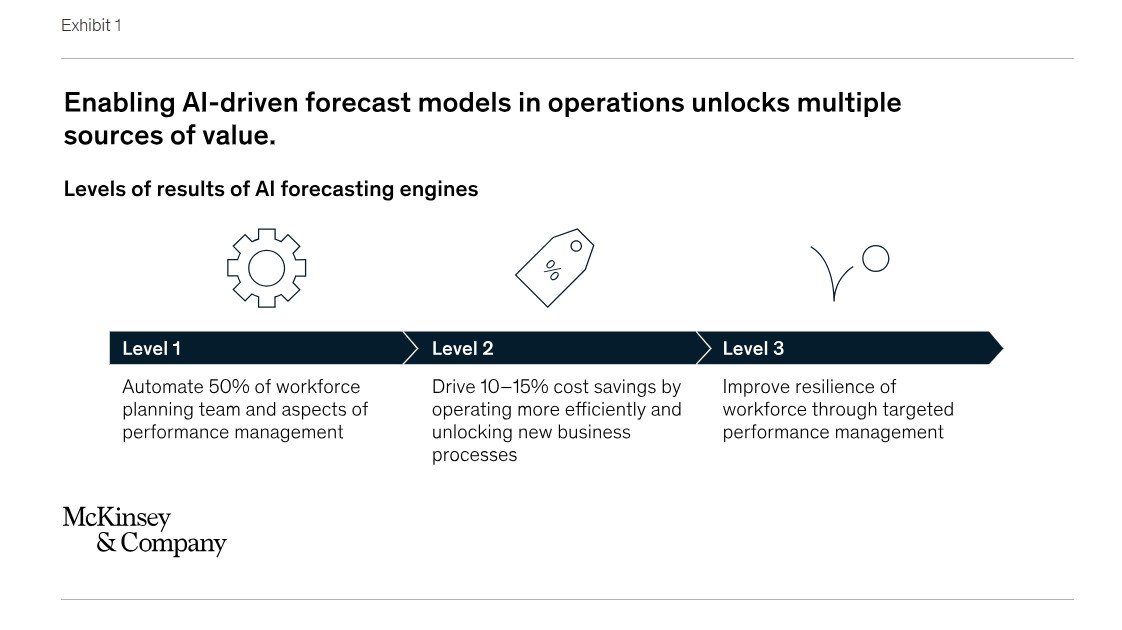
The value creation is massive. According to the same McKinsey analysis, AI in demand forecasting adds an estimated $1.2 to $2 trillion in value to manufacturing and supply chain planning globally.
Kinaxis expanded their Maestro platform with AI-powered concurrent planning, enabling companies to run demand, supply, and inventory optimization simultaneously rather than sequentially.
o9 Solutions deployed their AI platform at major CPG companies, replacing monthly S&OP cycles with continuous planning that responds to demand signals in hours, not weeks.
RELEX Solutions integrated machine learning into grocery demand forecasting, reducing food waste while improving on-shelf availability for retailers across Europe and North America.
According to a Rootstock Manufacturing Tech Survey, 94% of manufacturers now utilize some form of AI, with supply chain workflows increasingly driven by AI assistants and automation. The spreadsheet-based planning process that worked for decades has become a competitive liability.
In 2026, the real differentiators are how fast forecasts translate into business impact, how well they handle volatility, and how tightly they connect to inventory and execution.
This one's not optional anymore. Over 76% of organizations experienced a supply chain attack in 2024, according to the 2024 BlackBerry Cybersecurity Report.
The World Economic Forum’s Global Cybersecurity Outlook 2026 warns that these vulnerabilities are now the top challenge for 65% of large enterprises.
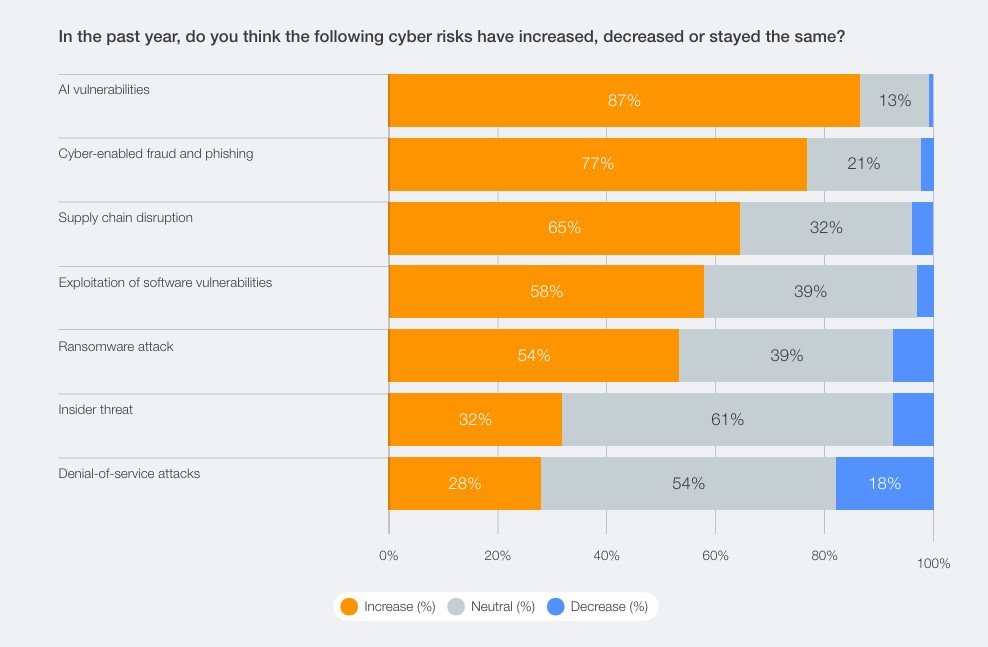
Consequently, the market for SBOM (Software Bill of Materials) management and compliance is surging, with projections reaching nearly $10 billion by 2030 according to Mordor Intelligence — a 12.8% CAGR driven by regulatory pressure and attack volume.
Microsoft enhanced their supply chain security requirements, mandating SBOMs from all software vendors and implementing zero-trust verification across their procurement processes.
Walmart expanded their cybersecurity requirements for suppliers, requiring real-time monitoring and incident response capabilities from technology vendors.
Maersk — after suffering a $300 million loss from the NotPetya attack — rebuilt their entire IT infrastructure with segmented networks and supply chain-specific security protocols.
Supply chain attackers are shifting focus from open-source to closed-source software targets. According to the WEF report, 64% of organizations are now accounting for geopolitically motivated cyberattacks in their risk mitigation strategies.
The new objective isn't to exploit endpoints — it's to compromise the software supply chain itself, embedding malicious code where applications are created and deployed.
Organizations that move now to lock down developer access, enforce dependency trust policies, and continuously verify code integrity will avoid being blindsided.
This isn't about corporate PR anymore. Regulatory pressure has made sustainability software a compliance requirement.
According to IntegrityNext's supply chain sustainability report, 73% of large corporations now obtain assurance on their sustainability disclosures to ensure access to capital, strengthen stakeholder trust, and manage risk.
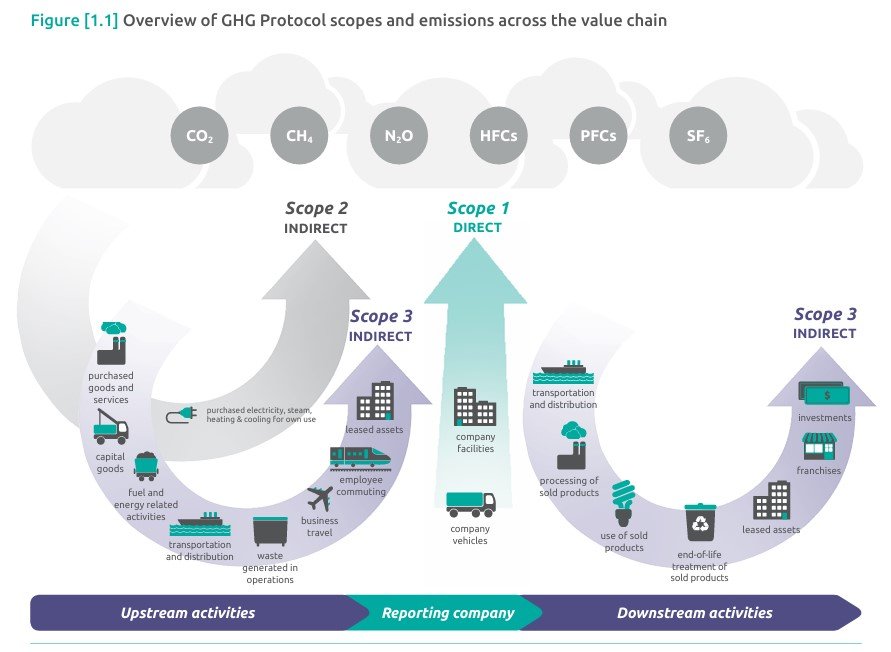
The EU's Corporate Sustainability Reporting Directive (CSRD) has extended reporting obligations to thousands of additional companies, with the underlying ESRS standards defining in detail which data must be disclosed.
The regulatory landscape is evolving rapidly, with frameworks like the EU Deforestation Regulation and California's climate disclosure rules showing increasing convergence.
SAP integrated sustainability management into their core ERP, enabling automated carbon footprint tracking across procurement, manufacturing, and logistics.
Salesforce launched Net Zero Cloud with supply chain emissions tracking, helping companies measure Scope 3 emissions across their supplier networks.
Sphera expanded their ESG platform to include automated regulatory compliance monitoring, alerting companies to upcoming disclosure requirements across jurisdictions.
Scope 3 emissions — those from your supply chain — significantly exceed direct emissions in many industries. The pressure from customers, investors, and business partners is intensifying around Scope 3 transparency.
In 2026, sustainability isn't about marketing stories. It's about operating systems. The big shift: sustainability succeeds when it makes products work better, last longer, cost less to run, and solve bigger customer problems.
Blockchain for supply chain has moved past the pilot phase.
The global blockchain for supply chain traceability market exceeded $3.55 billion in 2025 and is set to expand at a 31.6% CAGR from 2026 to 2035, according to GM Insights market research. In 2026, the industry size is estimated at $4.56 billion.
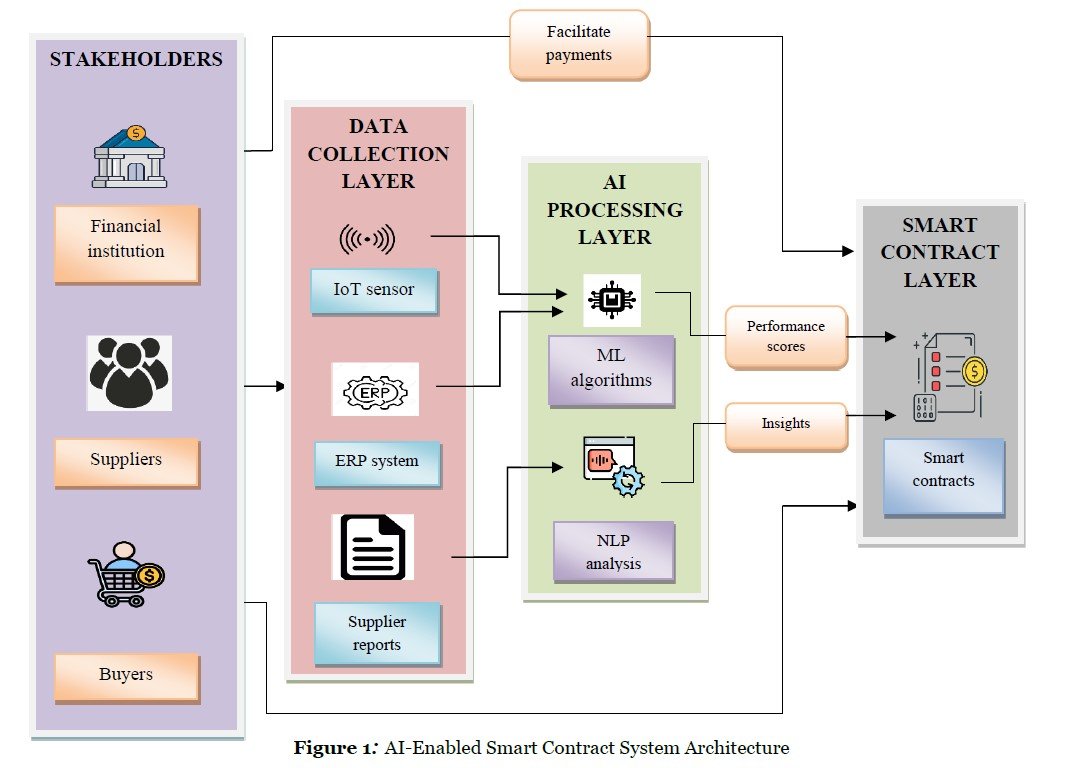
Source: AI-Enabled Smart Contracts for Financial Transactions in Supply Chains, JISEM 2024
The EU's sustainability directives — including CSRD and CSDDD — now require extensive supply chain transparency, with blockchain increasingly adopted as a verification tool. Smart contracts are automating 70-80% of key operational workflows such as purchase approvals, trade confirmations, shipping validation, and compliance checks.
Walmart mandated that leafy green suppliers use blockchain for traceability, reducing the time to trace produce from farm to store from 7 days to 2.2 seconds.
BMW deployed blockchain for tracking cobalt in EV batteries, ensuring ethical sourcing from mine to manufacturing.
Nestlé expanded their blockchain traceability program to cover coffee, milk, and palm oil supply chains, giving consumers QR-code access to product origin data.
In 2026, 25% of containers worldwide are now equipped with IoT devices, with the global smart container fleet expanding eightfold, according to Drewry research. Major fashion, electronics, and agriculture brands are embedding ethical sourcing modules for EU compliance.
The increasing demand for transparency and accountability is driving adoption. Businesses and consumers seek assurance of product authenticity, ethical sourcing, and regulatory compliance — and blockchain provides an immutable record.
The global supply chain network was shaken to its core by tariffs and geopolitical tensions. The response is a massive shift toward regional manufacturing.
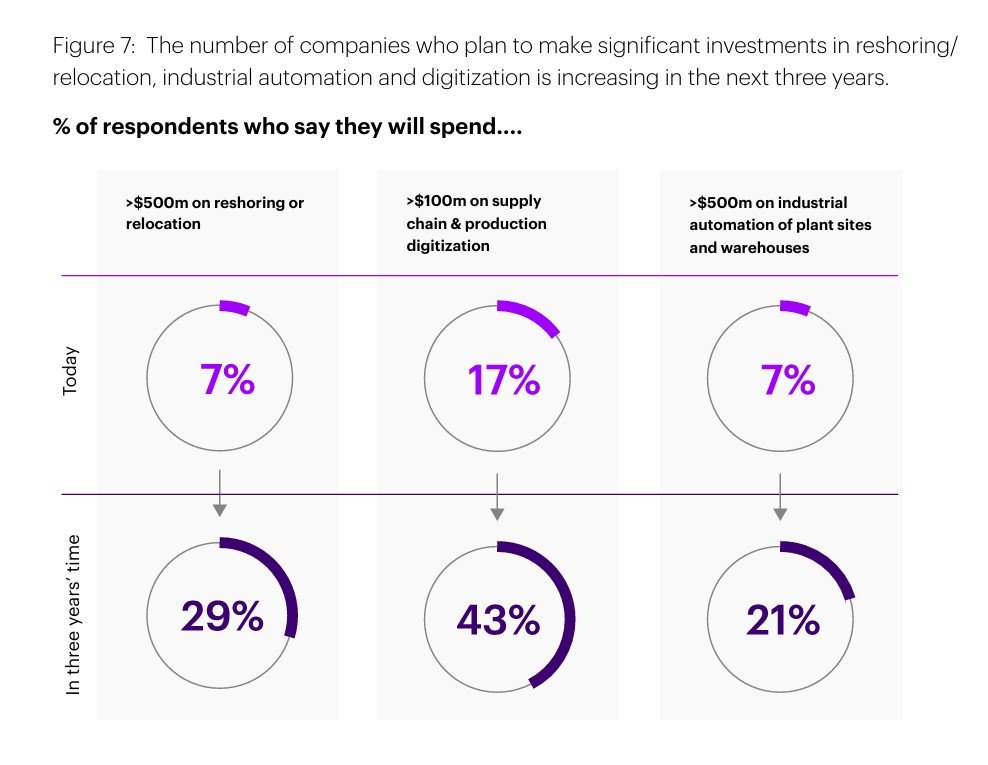
According to Accenture's global supply chain survey of 1,230 senior executives, 85% of companies now manufacture and sell most of their products in the same region — up from just 43% in recent years. In the U.S., that number has reached 91% (up from 52% previously).
Regional sourcing has nearly doubled to 65% in 2026, up from 38% in previous years. According to the same Accenture data, companies are now investing an average of $2.5 billion to digitize, automate, and relocate supply and production facilities.
Intel announced $20 billion in U.S. fab construction, with supply chain software supporting local supplier development and qualification.
Tesla expanded Gigafactory operations in Texas and Berlin, shortening supply chains for battery components and reducing exposure to trans-Pacific shipping volatility.
TSMC broke ground on Arizona facilities, with major semiconductor customers restructuring supply networks around the new North American capacity.
Three-quarters of retail supply chain leaders say tariff turbulence is redefining their 2026 strategies, prompting a widespread pivot toward regionalization and supplier diversification. 77% of supply chain leaders have already shifted sourcing away from China toward tariff-neutral countries.
The software opportunity: platforms that help companies model total cost of ownership across regions, identify and qualify new suppliers, and manage multi-node fulfillment networks are seeing explosive demand.
If supply chain teams are to keep up with the speed of AI development, they need software that is highly adaptable.
According to GM Insights, the cloud-based segment dominated the market, accounting for around 57% share in 2025 and is expected to grow at a 14.1% CAGR from 2026 to 2035.
The shift is fundamental. According to Supply Chain Management Review's 2026 predictions, the walls between traditionally separate supply chain technology categories are coming down.
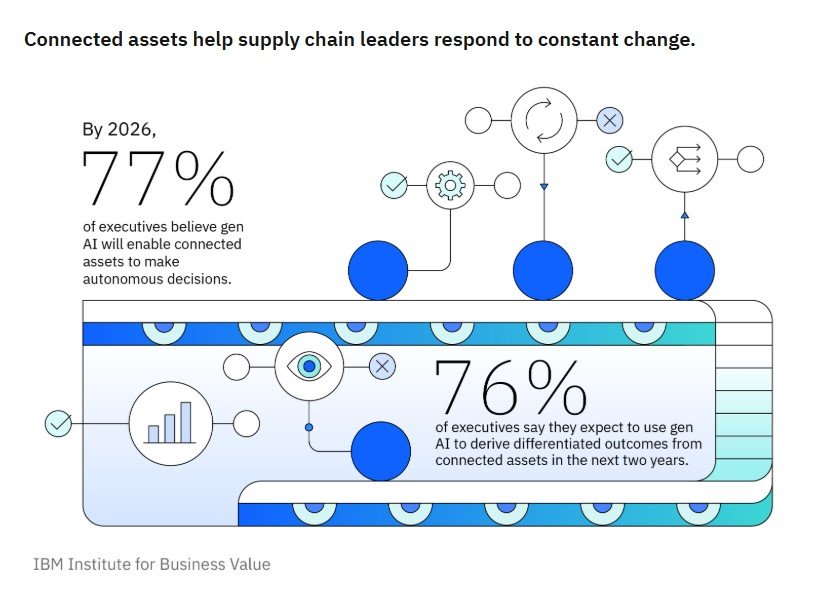
Source: IBM Institute for Business Value, "The Intuitive, AI-Powered Supply Chain" 2024
As companies grow more comfortable with AI infrastructure, data silos will collapse, workflows will reorganize around intelligence, and platforms will manage more of the value chain end to end.
Microsoft launched their Supply Chain Platform as "an open, collaborative and composable foundation for data and supply chain orchestration" — building blocks across Azure, Dynamics 365, Teams, and Power Platform.
Blue Yonder restructured their platform around microservices architecture, enabling customers to adopt capabilities modularly rather than requiring full platform replacement.
Coupa expanded their business spend management platform with composable supply chain modules, allowing procurement, supply chain, and finance teams to work from unified data.
Companies need an agile, targeted, and lightweight approach to using software and AI in supply chains that maximizes impact. The monolithic ERP implementations that took years and tens of millions of dollars are giving way to composable architectures that can adapt in weeks.
One key thing to look out for: extensible software that allows companies to plug in best-of-breed AI capabilities as they emerge, rather than waiting for their primary vendor to catch up.
The last mile accounts for as much as 50% of overall logistical expenses. Autonomous delivery is finally ready to change that math.
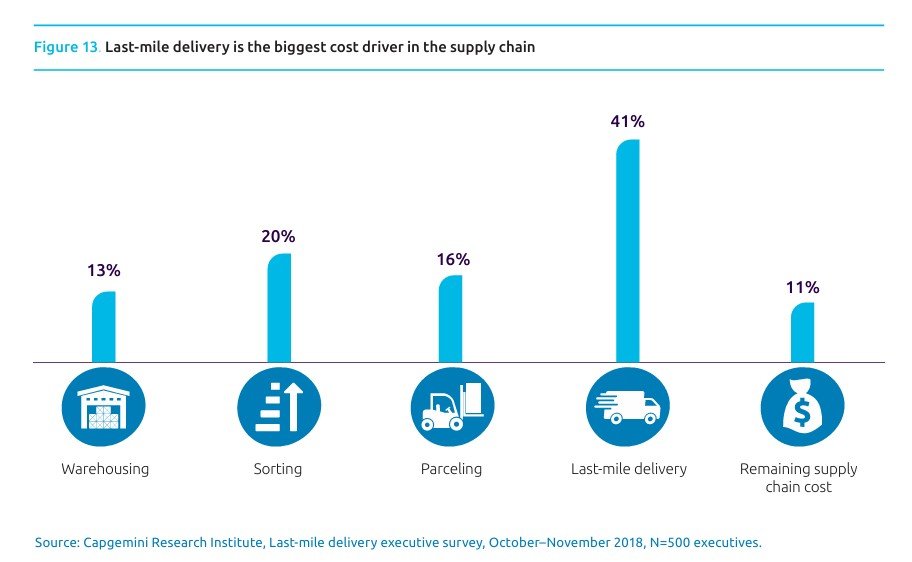
According to Future Market Insights drone logistics research, the drone logistics and transportation market has reached $2.1 billion in 2026, driven by adoption in e-commerce and healthcare.
The cost impact is dramatic. Studies show that drones can reduce delivery costs per parcel by potentially 70% compared to traditional methods. The global cargo drone market is projected to reach $29.38 billion by 2034, growing at a 34.55% CAGR.
Zipline surpassed 100 million commercial autonomous miles with over 1.4 million deliveries, operating the world's largest autonomous delivery system for medical supplies and retail goods.
Wing (Alphabet) completed over 450,000 deliveries and announced expansion with Walmart to 100+ stores across Dallas, Atlanta, Charlotte, Houston, and Orlando.
Amazon expanded Prime Air drone delivery to new markets, targeting millions of customers eligible for drone delivery by end of 2026.
90% of self-driving delivery vehicles now use AI-driven route optimization that adapts in real time to traffic conditions, road closures, and weather patterns. The integration of AI and machine learning is transforming cargo drones with intelligent route optimization, predictive maintenance, and adaptive load management.
Regulatory hurdles and infrastructure limitations remain, but the economics are becoming impossible to ignore. For suburban and rural deliveries, autonomous options will increasingly outcompete traditional last-mile networks.
The shift from "what happened" to "what will happen and what to do about it" is reaching a tipping point.
According to a recent industry-wide review on AI in logistics and Oracle's demand forecasting analysis, AI adoption can cut logistics costs by 15% and boost service efficiency by 65%.
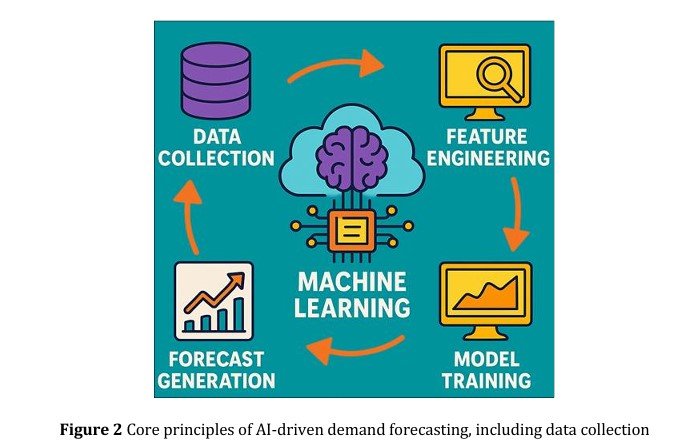
Source: R.V. Rungta, World Journal of Advanced Engineering Technology and Sciences, 2025
Companies are now using AI-based control towers to integrate previously siloed procurement, manufacturing, and logistics data, along with machine learning algorithms that ingest external signals like weather patterns, port congestion data, and social sentiment.
Maersk deployed predictive analytics across their container shipping network, anticipating port congestion and rerouting vessels before delays cascade.
Procter & Gamble integrated weather, social media, and point-of-sale data into demand sensing algorithms, improving forecast accuracy for promotional periods.
DHL expanded their Resilience360 platform with predictive risk scoring, alerting customers to potential disruptions before they impact operations.
Perhaps the biggest shift of 2026 is how AI transforms the pace of planning and decision-making. AI accelerates this process exponentially, and as data accuracy improves, AI's influence will extend into capital spending, manufacturing strategy, and capacity planning.
The key trend: "predictive orchestration." It's not enough to predict what will happen — the winning systems recommend actions and, increasingly, execute routine responses automatically.
Look at these twelve trends together and a pattern emerges: supply chain software is being rebuilt from the ground up.
AI isn't just optimizing existing processes — it's taking over entire decision loops. Visibility isn't just dashboards — it's becoming the foundation for autonomous response. And the platforms that won deals five years ago are being displaced by composable architectures that can adapt at the speed of change.
The supply chain leaders who thrive in 2026 aren't the ones with the most sophisticated technology. They're the ones who understand what the machines can't do:
Every trend in this list — from agentic AI to autonomous delivery — points in the same direction: the foundational skills of supply chain management (understanding customers, managing risk, building trust with partners) matter more than ever, even as tactical execution gets automated.
The tools have changed. The game hasn't.
Want to spot emerging supply chain trends before they hit mainstream? Check out our guide on how to identify market trends or explore what's gaining traction on our trends dashboard.
+24,000 Emerging Trends
+4,000 Breakout Apps
+70 Mega Trends
Trend Analysis Tool